How Secret Santa Works: The Complete Beginner's Guide
Picture this: it's October, someone in your group chat sends "should we do Secret Santa this year?? 🎄" and three people reply YES before you've even had your morning coffee. Now you're either organizing the whole thing or nervously waiting to find out who you drew.
Either way — you need to know how Secret Santa actually works. The rules, the name draw, what happens when someone drops out at the last minute, and how the whole thing ends without anyone going home quietly annoyed. This is that guide.
The Basic Idea (and Why Everyone Keeps Doing It)
Secret Santa is a gift exchange where everyone in the group buys a gift for exactly one person — and nobody knows who bought them their gift until the reveal. The "secret" is the whole point: you're shopping for someone specific, wrapping something up, and handing it over without giving yourself away.
It works because it's genuinely fair. Instead of buying presents for every single person in your office, family, or friend group, you buy one thoughtful gift and put all your energy there. Everyone gives one, everyone gets one. No one's quietly calculating who spent what on whom.
How a Typical Exchange Works, Step by Step
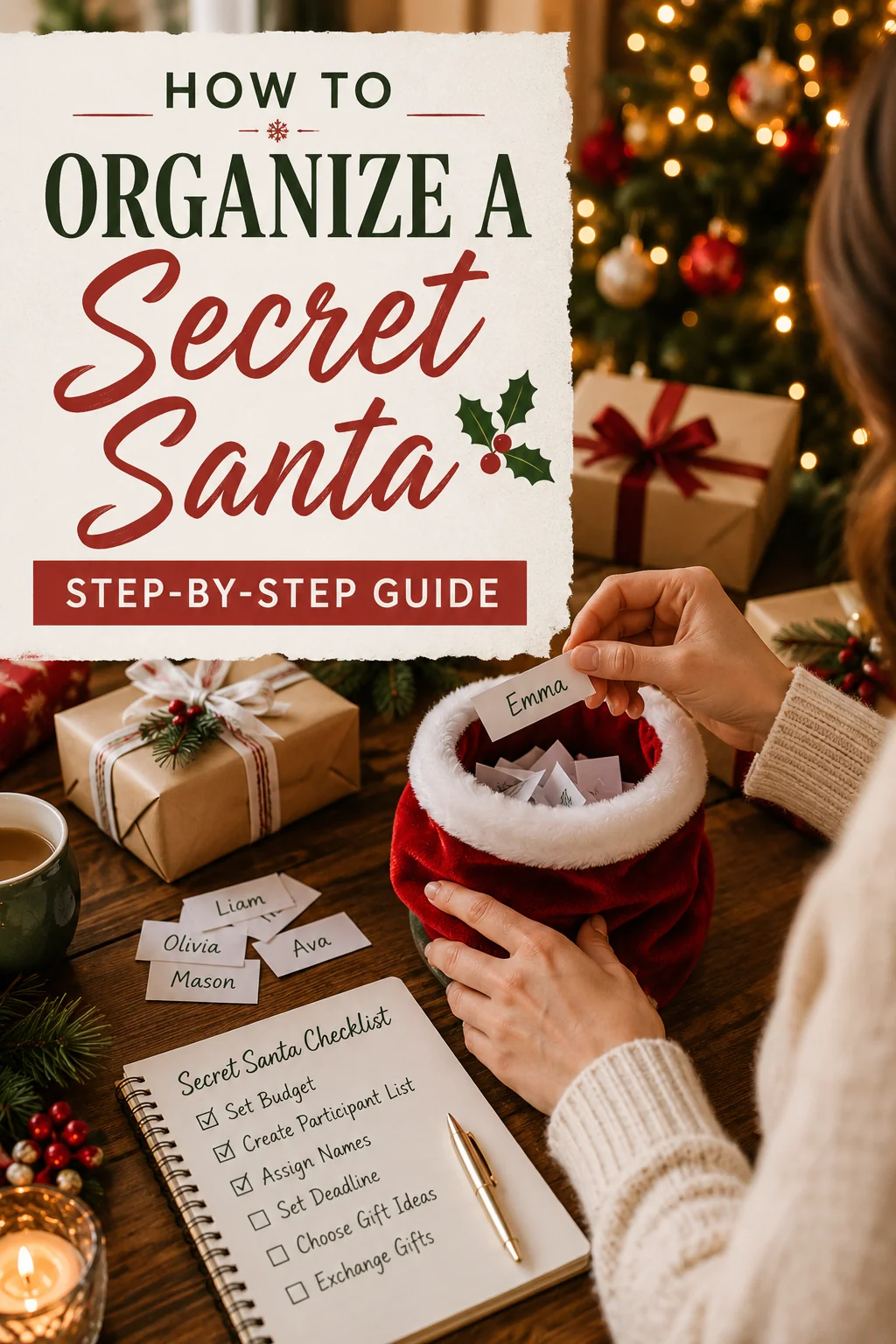
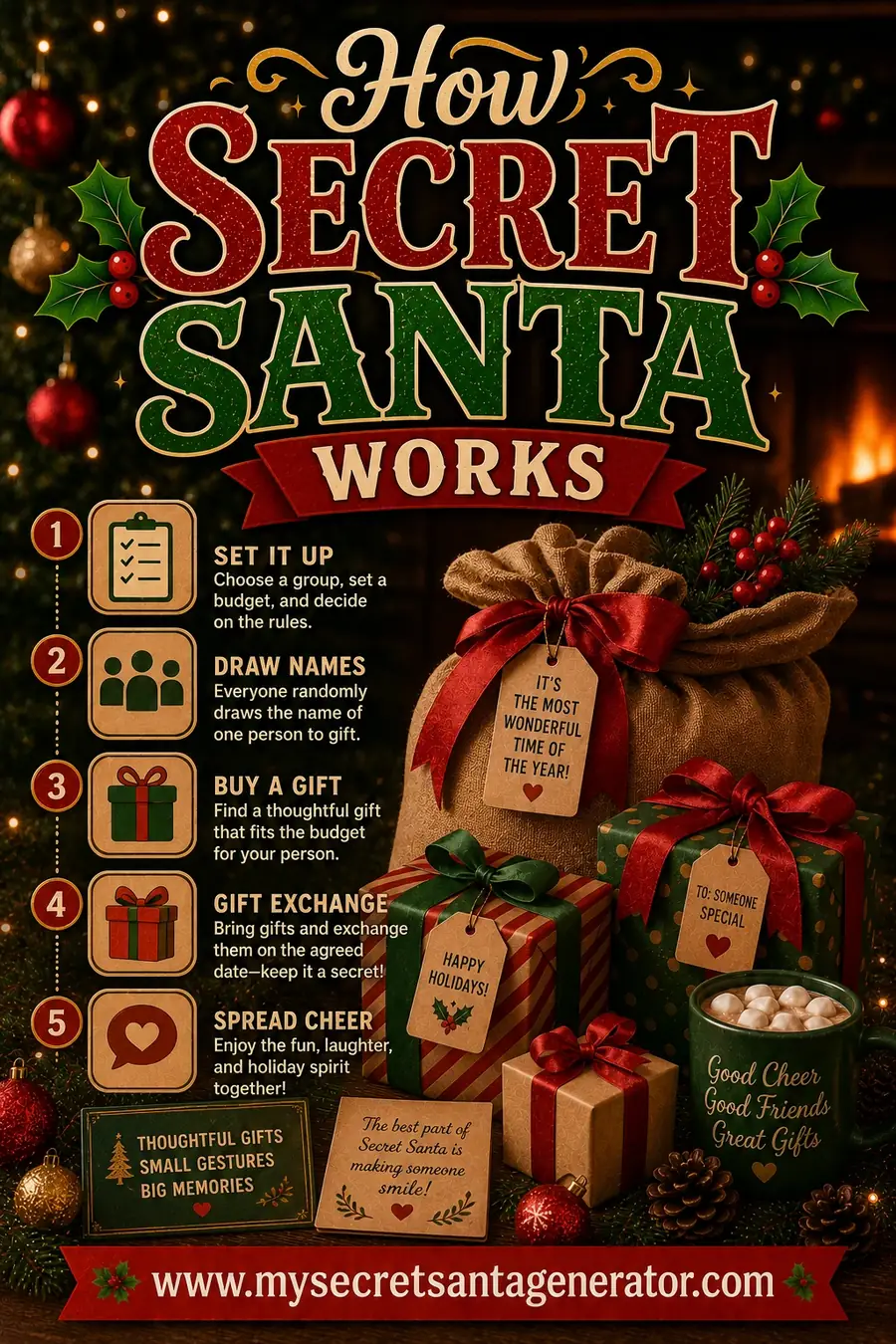
Step 1: Decide on the group. Lock in the list early. Is it your whole office or just your team? Immediate family or extended? The friend group minus the two people who bailed on the last three hangouts? Get everyone confirmed before the draw, because adding people after the fact is a logistical headache.
Step 2: Set the budget. This is the most important step, and it happens before anything else. Without a cap, someone shows up with a $12 candle and someone else rolls in with a $90 cashmere sweater — and now it's awkward for everybody. Common ranges: $15–$20 for casual friend groups, $20–$30 for office exchanges, $30–$50 for close family. Pick a number that works for your lowest-income participant, not your highest.
Step 3: Draw names. Everyone's name goes into the pool. Each person draws one — that's their giftee. Two rules apply: you can't draw your own name, and the whole point is that no one knows who drew them.
Step 4: Shop and wrap. Now the fun part. You've got a name, a budget, and a deadline. Go find something they'll actually like.
Step 5: The reveal. On exchange day, everyone brings their wrapped gift. Depending on your group, either gifts get distributed privately or you open them one by one in front of everyone. The best part is finding out who gave you yours — the reveal is the payoff for all the secrecy.
That's the whole thing. Five steps. The magic is in how you run each one.
The Name Draw: How to Actually Pull It Off
The classic method is the hat — write everyone's names on slips of paper, fold them up, toss them in a bowl, and have everyone pick one. It works perfectly for small groups where you're all in the same room.
The problem: hats don't handle exclusions (couples usually shouldn't draw each other), they can't send assignments to people in different cities, and the organizer almost always ends up seeing the whole draw. That's more information than they should have.
For anything larger than about eight people, or any group that isn't all in one place at the same time, a free online Secret Santa generator is genuinely better. You add everyone's names, set any exclusions, and each person gets their assignment sent directly to their own email — so the organizer never sees who drew whom. It's actually more secret than the hat method.
Exclusions: The Rule That Saves Awkward Moments
Most groups set exclusions so couples or partners don't draw each other. The logic: you're presumably already buying each other gifts, so the Secret Santa draw should mix things up. You can also exclude close siblings, or anyone involved in a separate gift exchange outside this group.
The key is deciding exclusions before the draw. Trying to swap assignments after the fact means the organizer learns things they weren't supposed to know — and now the whole secret part is compromised.
The Rules That Actually Matter
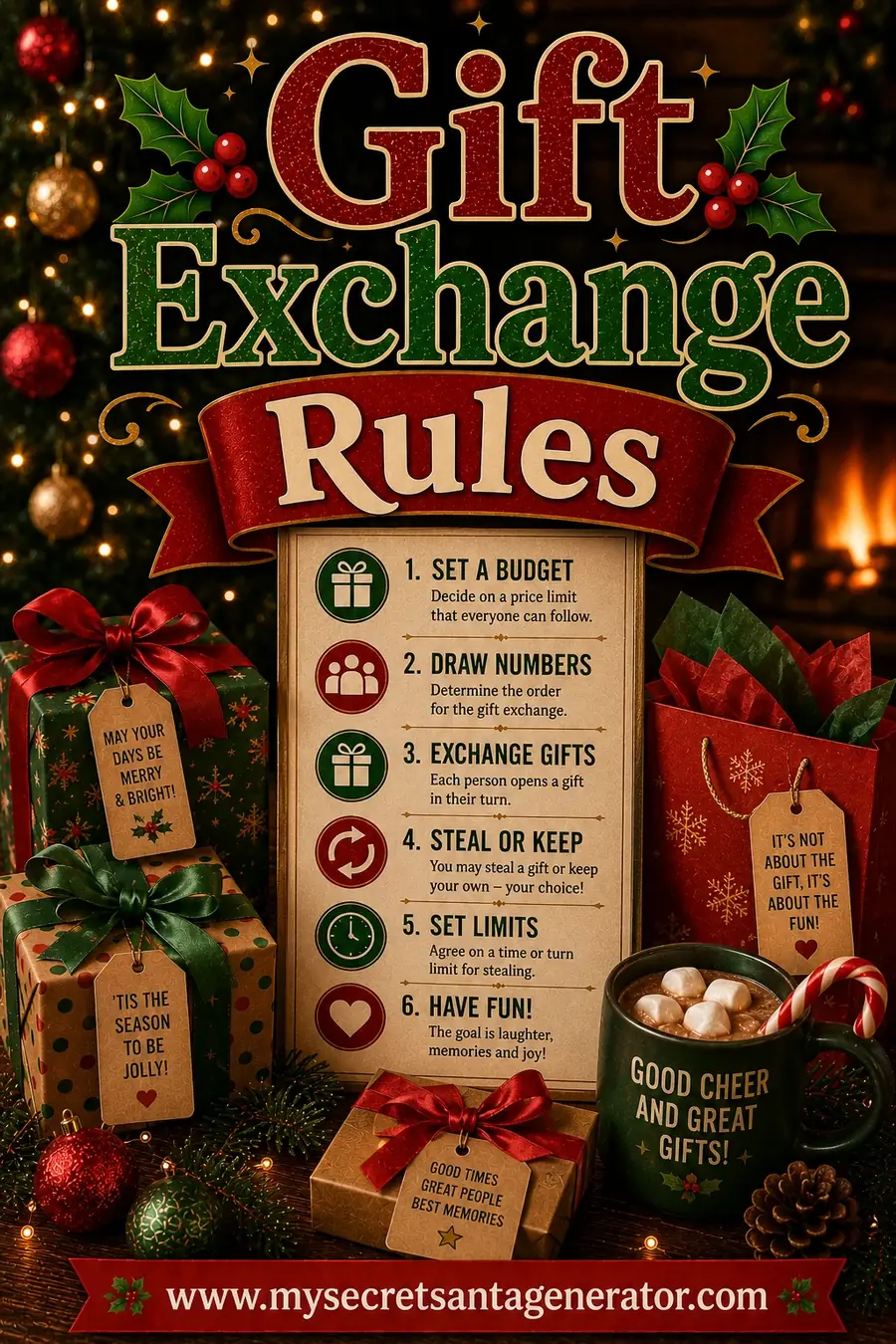
Secret Santa rules vary by group, but these are the ones nobody should break:
- Stick to the budget. Both directions. Don't spend significantly less because you don't know the person well, and don't overspend to look generous. The cap is the cap.
- Stay anonymous until the reveal. This means no hints, no telling your best friend who you drew, no accidentally leaving a receipt in the bag with your name on it.
- Wrap it properly. A bag with tissue paper is fine. The Amazon box it arrived in, handed over with the packing slip still inside, is not.
- Show up. If you're in, you're in. Dropping out two days before the exchange leaves your giftee with nothing — that's a genuinely bad thing to do to someone.
What Happens When Someone Drops Out
Someone always does. Life happens. The practical options:
- If there's time, redraw so another participant covers the absent person's giftee.
- If it's last minute, the organizer usually buys a neutral backup gift themselves.
- Some groups keep a "spare" — a nice generic item bought in advance — specifically for this scenario.
It's worth deciding your drop-out policy upfront. "If you bail after the draw, you owe the group a gift anyway" is a totally reasonable rule, and it tends to cut down on last-minute exits.
Secret Santa in Different Situations
The format is the same everywhere, but the vibe shifts:
Office Secret Santa usually calls for more conservative choices — keep it professional, skip anything too personal, read the room before you go full novelty gift. Neutral wins: good snacks, nice candles, desk accessories, quality coffee.
Family Secret Santa often involves a wider age spread and more complex exclusions. Are the kids in a separate pool? Do cousins exclude each other? Do spouses draw from the same pool? Sort this out before the draw, or you'll be re-drawing three times.
Friend group Secret Santa is where you can actually have fun. Themes, more personal gifts, inside jokes — this is where the format shines. You actually know your giftee, so use that.
Virtual Secret Santa works exactly the same way, except everyone ships their gift directly to their person's address. Add extra time for shipping, and collect addresses through a private form rather than the group chat.
A Few Things That Make It Actually Good
Most Secret Santa exchanges are fine. These are the things that make them genuinely fun:
Send a wishlist or questionnaire first. Even just knowing someone's favorite snack, a current hobby, or their coffee order helps enormously. Nobody likes shopping completely in the dark, and nobody likes receiving something that's clearly a wild guess.
Set a real deadline. "Sometime before Christmas" leads to people handing over gifts at 9pm on the 23rd. Give a specific date and stick to it.
Do the reveal together. Opening gifts one at a time in front of the group — and having the giver reveal themselves at the end — is genuinely more fun than quietly collecting your present and leaving. The big reveal is the whole point of the secrecy.
Keep it low-pressure. Secret Santa is supposed to be enjoyable. If the budget is stressing people out, lower it. If someone can't participate this year, let them opt out without drama. The goal is a good time, not an obligation.
Frequently Asked Questions
How many people do you need to play Secret Santa?
Technically three, but five or more is where it actually gets fun. With just three people, everyone figures out who drew whom pretty quickly — there's not much mystery. Six to twenty is the sweet spot where the secrecy holds and the reveal is genuinely exciting.
Can the organizer also participate in Secret Santa?
Yes — just use an online generator that keeps everyone's assignment private, including the organizer's. Most good tools have this built in, so the person who set up the draw still doesn't know the full picture.
What if someone gets a gift they really don't like?
Smile, say thank you, and quietly donate it later if needed. The spirit of the exchange is in the gesture. That said, a wishlist or questionnaire beforehand cuts down on the "genuinely unwanted gift" problem dramatically.
Do you have to reveal who you are at the end?
Not necessarily — some large office exchanges keep givers anonymous permanently. But most groups reveal at the end, and honestly it's the best moment of the whole thing. Finding out who put all that thought into your gift is half the fun.
What's the difference between Secret Santa and White Elephant?
In Secret Santa, you're assigned one specific person and you buy something for them. In White Elephant, you bring a generic gift and everyone picks or steals from a communal pile. Completely different energy — Secret Santa is personal, White Elephant is competitive chaos. Both great, just different.
What do you do if you accidentally draw your own name?
Redraw. If you're using a hat and keep pulling yourself (it happens more than it should), switch to an online generator — they handle this automatically and you never have to awkwardly unfold and refold that slip of paper three times.