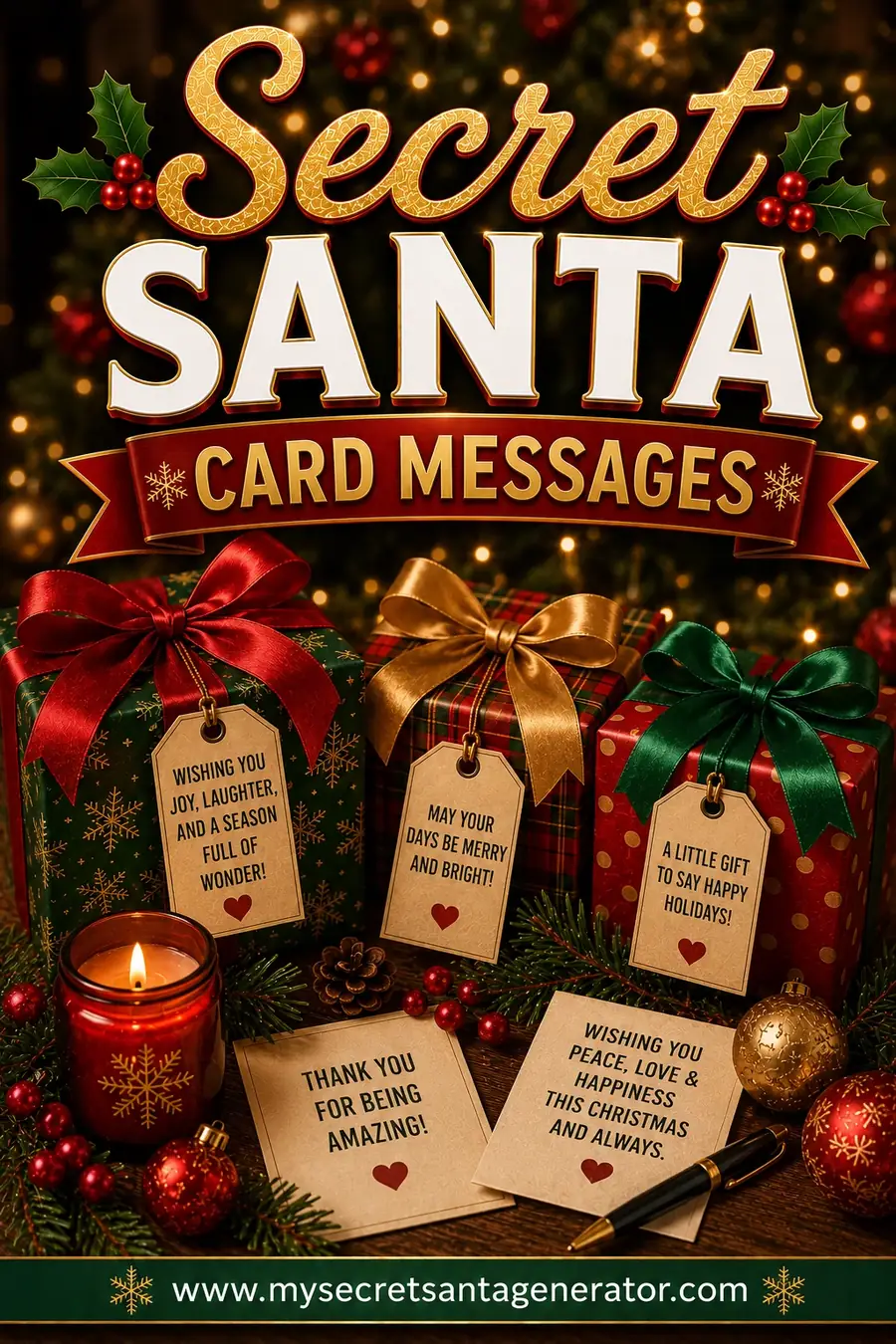
Secret Santa Messages: What to Write in the Card
The card message is the part most people spend the least time on and feel the most uncertain about. "Hope you like it!" works. But a genuine, specific message — even two sentences — is the part of a Secret Santa gift that actually stays with someone.
These messages are sorted by relationship and tone. Copy them directly, combine pieces from multiple examples, or use them as a starting point to write something in your own words.
Messages for a Coworker or Office Exchange
Professional and warm:
"Happy holidays — I hope this is exactly the right call. Wishing you a restful end to the year."
Warm with light humor:
"Office Secret Santa is a tradition I take very seriously. I drew your name and selected with care. Happy holidays."
Acknowledge the situation honestly:
"We work in the same general direction of the building and I know your coffee order — I figure that's enough to go on. I hope you enjoy this. Happy holidays."
When you don't know the person well:
"I drew your name and did my best. I hope this lands. Enjoy the holidays."
When you do know them:
"I know you've had a full year. This is small but chosen specifically. Happy holidays — you've earned the break."
Messages for a Close Friend
Personal and warm:
"I know you, and I got you something I think you'll actually use and enjoy. Merry Christmas — I'm glad we do this every year."
Noticing the year:
"This year happened. You navigated it. Here's something that's just for you, with no obligations attached."
Something heartfelt without being heavy:
"This is for you specifically, not just a generic person on a list. I thought about what you'd actually want and got as close as I could."
Short and genuine:
"Merry Christmas. You're one of my favorite people."
Messages for a Family Exchange
Warm and direct:
"Merry Christmas — I hope this is exactly what you needed, and if not, I hope it's at least something you enjoy."
Acknowledging the season:
"Another year of doing this together. I love that we still do this. Enjoy the gift — I picked it with you specifically in mind."
For someone older:
"The year goes faster every time. Happy Christmas — I picked this because it felt like you."
For someone younger:
"Merry Christmas! I hope this is good. Let me know what you think."
Messages When You Don't Know the Person Well
One of the harder card situations: you drew someone you know only a little. The temptation is a generic message. The better approach is honest warmth:
Acknowledge the situation:
"I don't know you as well as I'd like, but I did my research. I hope this works."
Keep it warm and short:
"Chosen carefully, with good intentions. Enjoy the holidays."
Go genuine over generic:
"Happy holidays — I hope this is the right call. Either way, it comes with good wishes."
For a Secret Santa group that's mostly strangers:
"Drawn out of a hat, chosen with thought. Happy holidays."
Messages for a Funny Gift
Lean into the self-awareness:
"I thought about this more than you might expect. I stand by it."
For a gag gift:
"This is the best version of this specific type of terrible gift. You're welcome."
When the gift is deliberately bad:
"I saw this and thought of you. I'm not entirely sure what that says about either of us."
When you wrapped something unexpectedly practical:
"I know. It's not glamorous. But you mentioned you needed one and here we are."
What Makes a Secret Santa Message Actually Good
The difference between a good card message and a forgettable one is almost always specificity. Compare:
Generic: "Hope you enjoy this! Happy holidays!"
Specific: "I got this because you mentioned your current one was worn out. Figured it was time for a better version. Happy holidays."
The specific version isn't longer. It's not more effusive. It just contains one real observation, and that's what makes it land.
The same applies at scale:
- "Wishing you a restful holiday season" → fine
- "You've had a full year — I hope the break is actually restful this time" → better
The upgrade requires only that you notice something true about the person or situation and say it directly.
Messages for the Long-Distance or Virtual Exchange
When the gift arrives by mail and there's no in-person reveal, the card message carries more weight — it's the entire experience of the exchange for the recipient until the reveal call.
When shipping directly to them:
"This is coming to you from [your location], which is farther than I usually ship things.
I hope it arrives in good shape and at the right time.
Happy holidays from a distance."
For a virtual exchange with a reveal call:
"Don't open this until the call.
(Or open it now and pretend you're surprised.
I won't know either way.)
Happy holidays — looking forward to seeing you on the [date]."
When the gift might be late:
"Shipping was involved. Shipping is unpredictable.
I hope this arrived when it was supposed to.
If it didn't, the thought was there before the package was.
Happy holidays."
When the recipient lives somewhere with long shipping times:
"I added time to the shipping estimate.
I still wasn't sure. But it's out there, moving toward you.
Merry Christmas — I hope the timing works."
The virtual exchange card has a different job than the in-person one. It needs to span the distance between sending and receiving, often across days or weeks. Acknowledging the distance is almost always warmer than pretending it doesn't exist.
Short Messages That Work for Any Gift
"Chosen with you specifically in mind. Happy holidays."
"Something small, but genuine. Enjoy the season."
"I hope this is exactly right — happy Christmas."
"Merry Christmas. The thought behind this was better than the wrapping suggests."
"For you, specifically. Not just anyone on a list."
Frequently Asked Questions
What should you write in a Secret Santa card?
Something short and specific: who you are (if not anonymous), something genuine about the gift choice, and a holiday close. Two to four sentences is the right length. One true observation about the person or the selection is worth more than a paragraph of generic warmth.
What do you write when you don't know the person?
Acknowledge the situation honestly and keep it brief: "I drew your name and did my best. I hope this lands. Happy holidays." Honest brevity is significantly better than false familiarity.
Should Secret Santa messages be funny or serious?
Match the group. Office exchanges call for warmth with optional light humor. Close friend groups can go funnier. Family exchanges usually suit something warmer and more direct. When in doubt, lean slightly warmer.
How long should a Secret Santa message be?
Two to four sentences. Long enough to be genuine, short enough to be read before opening the gift. A single good sentence is better than four mediocre ones.
What do you write in an anonymous Secret Santa card?
Write in character as the anonymous gifter: "From someone who noticed you mentioned [X]." / "From your anonymous admirer of your taste in [category]." The warmth and specificity can come through without the name.
Can you leave the card blank and just sign your name?
Technically yes, but a blank card signals low effort regardless of what's inside. Two genuine sentences take under a minute and change how the gift lands. The card is part of the gift.