Secret Santa Card Messages: What to Write for Every Situation
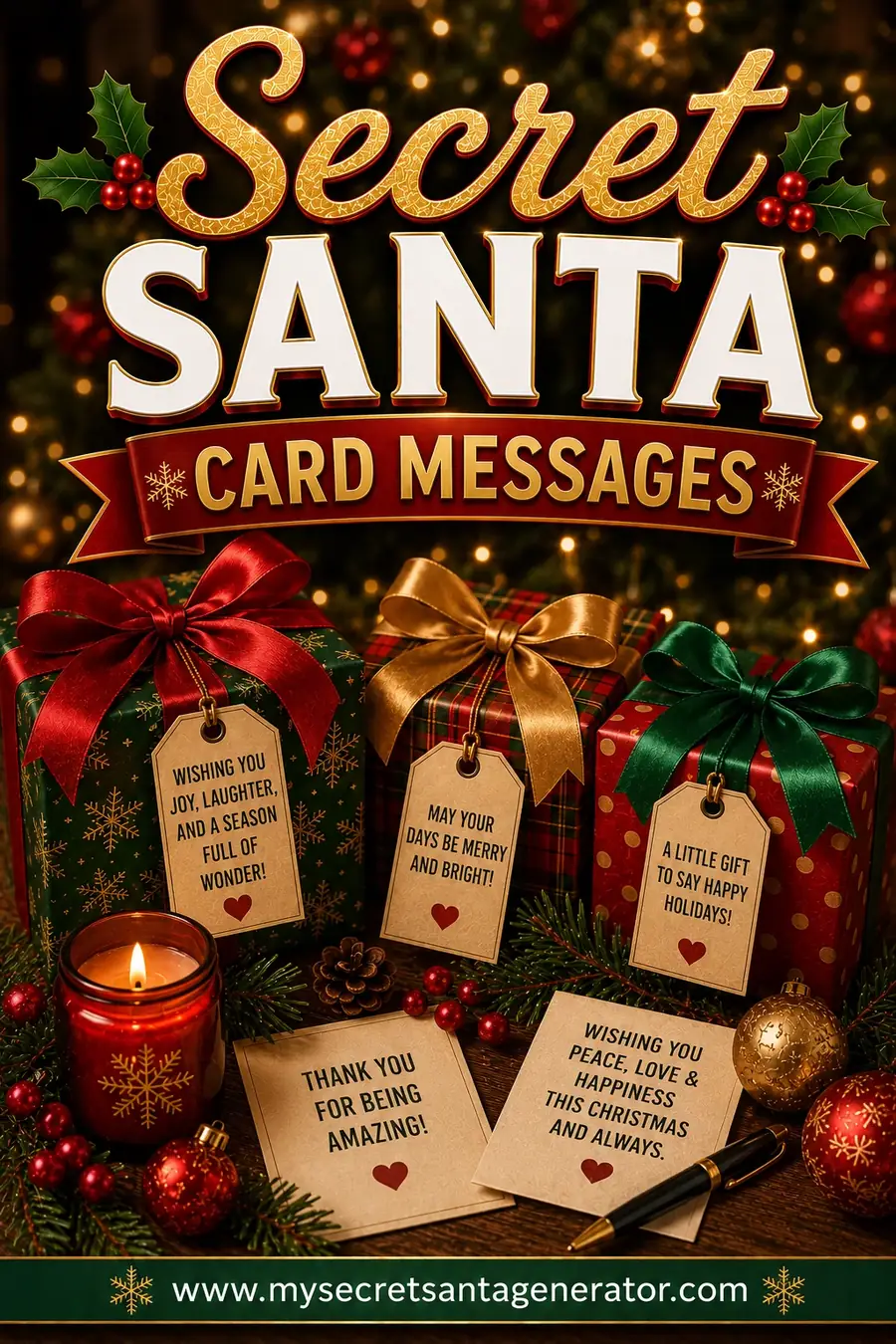
Most people spend thirty seconds on the card and thirty minutes on the gift. The card is where the experience actually lives. A gift without a message is just an object; a message with a gift is a moment.
These card messages are organized by relationship, situation, and tone. Copy them directly, or use them as a starting point to write something more specific to your person.
Office and Professional Exchanges
The workplace card has a narrower range — professional enough to not create awkwardness, warm enough to be genuine. These work for any professional setting:
For someone you work near:
"Happy holidays — I hope this is a good choice for you. Wishing you a proper rest over the break."
For a colleague you respect:
"Happy Christmas — I drew your name and took it seriously. I hope it reflects that."
For someone who's had a visible year:
"You've put in a lot this year. I hope the break actually sticks. Happy holidays."
When you barely know them:
"I did my research. Happy holidays — hope this lands."
Light humor, workplace appropriate:
"Office Secret Santa tradition, upheld once again. Here's something I actually thought about. Happy holidays."
Close Friends
For people you actually know, the card should sound like you. These are starting points — adjust the voice:
The honest version:
"I drew your name and was happy about it. I know you, and I got you something I think you'll actually like."
Reference the year:
"What a year you've had. Here's something that's just yours — no work, no obligations, just a small good thing."
Short and real:
"Merry Christmas. You're one of the people I'm genuinely glad to know."
When you picked something specific:
"I remembered you mentioned this category once, months ago, and I thought — that's the gift. I hope I was right."
For a best friend:
"Nobody else's card would say what this one says, and you'll understand why when you open it."
Family Members
For Parents or Older Relatives
"Happy Christmas. I love that we still do this together."
"Another year, same people, which is the best possible outcome. Merry Christmas."
"I picked this because it felt like you. I hope I was right. Happy holidays."
"The year goes faster every December. I'm glad you're in mine. Merry Christmas."
For Siblings
"I know you. I got you something you'll actually use. You're welcome in advance."
"Merry Christmas — I considered and rejected seven other options before landing on this. You'll understand when you see it."
"Happy Christmas. You're still my favorite sibling. (You are also my only sibling. But still.)"
For Kids (When an Adult Draws a Child)
"Happy Christmas! I hope you love this. Let me know what you think!"
"This is for you specifically — I picked it with you in mind. Enjoy it!"
"Merry Christmas! I hope this is exactly what you wanted."
For When You're Anonymous
If the exchange is anonymous, the card is your only communication. Make it warm enough to be meaningful without revealing yourself:
Warm and anonymous:
"From someone who noticed you'd enjoy this. Happy holidays."
Playful:
"Your Secret Santa did their homework. You'll find out who after the reveal. Enjoy."
Acknowledging the situation:
"One of the people in this room picked this specifically for you. That's all you're getting until the reveal."
For a long anonymous gifting period:
"From your anonymous admirer of your taste in [general category]. This is the first of several clues."
For Funny or Unusual Gifts
When the gift is deliberately chaotic:
"I saw this and felt strongly. I'm prepared to defend this choice."
For a gag gift:
"This is the highest quality version of this ridiculous thing. You're welcome."
When the gift is ironic:
"This is exactly what it looks like. I am extremely proud of it."
When you wrapped something absurdly practical:
"You said you needed one. Now you have one. Happy Christmas."
For white elephant or Dirty Santa:
"Steal-worthy. Don't say I didn't warn you."
Card Messages for Specific Gift Types
The right message varies by what's inside. A food gift card message that emphasizes the impermanence ("this will be gone in three weeks and that's the plan") lands differently than one that treats the gift as a lasting thing. Matching the message to the gift type produces more coherent results:
For a food or consumable gift:
"Something to enjoy and actually use up — which makes it a better gift than most things you could own.
Happy holidays."
For a cozy or comfort gift:
"For the good hours. You know the ones.
Happy Christmas."
For a practical everyday item:
"You mentioned needing a better version of this.
I was listening.
Happy holidays."
For a personalized gift:
"I made this specific to you — which means if it doesn't land, I have misunderstood you,
which I'm prepared to discuss.
But I think it'll land.
Merry Christmas."
For a book:
"There's a world in this. I thought it was yours.
Happy holidays."
For an experience gift:
"This starts later — when you're ready, when the timing works.
I've given you something to look forward to.
That felt like the right gift."
For a gift card:
"The decision of exactly what is yours.
The intention is mine: I wanted you to have something from a place I knew you'd like.
Happy holidays."
Matching the card message to the gift type tightens the overall experience — the wrapping, the gift, and the words all tell the same story rather than three slightly different ones.
The One Thing Every Good Card Message Does
Regardless of tone or relationship, every card message that actually lands does one thing: says something you mean.
"Happy holidays" is fine. "Happy holidays — you've had a full year and I hope the break is actually restful" is better. The second one is only nine words longer and contains one real observation. That's the upgrade.
You don't need a paragraph. You don't need to be profound. You need one true sentence about the person, the gift, or the occasion — and the rest is just a warm close.
Frequently Asked Questions
What's the best thing to write in a Secret Santa card?
Something specific and short. One genuine observation about the person or the gift selection, followed by a warm holiday close. Two to four sentences. "I drew your name and took it seriously. I hope this reflects that. Happy holidays." is enough.
What do you write in a work Secret Santa card?
Professional warmth: "Happy holidays — I hope this is the right call. Wishing you a good break." Light humor is fine in most workplaces. Avoid anything personal or potentially awkward. Two sentences is the right length for a colleague you don't know well.
What do you write in a funny Secret Santa card?
Own the choice fully: "I saw this and immediately thought of you. I'm not sure what that says about either of us." The self-awareness and ownership make gag gifts land significantly better.
Is it okay to leave a Secret Santa card blank?
It's technically fine, but it signals low effort regardless of how good the gift is. Thirty seconds and two genuine sentences change how the gift is received. The card is part of the experience.
Should you sign your name in an anonymous Secret Santa?
Not until the reveal. Sign "your Secret Santa" or "your anonymous gifter" and let the guessing be part of the experience. The card can be warm and personal without containing your name.
How long should a Secret Santa card message be?
Two to four sentences. Short enough to read before opening the gift, long enough to say something genuine. One true sentence is worth more than a paragraph of generic holiday wishes.