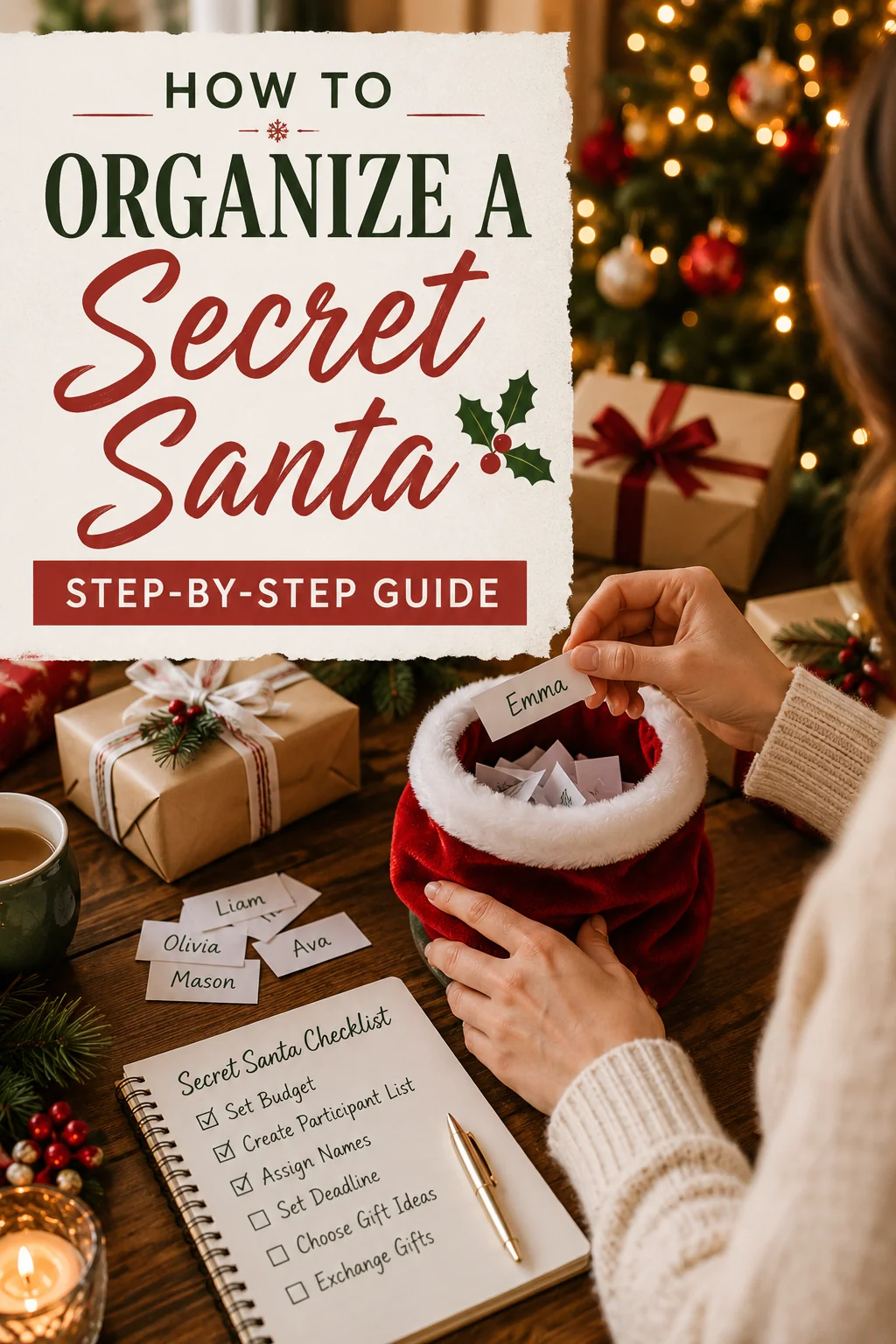
Secret Santa for a Large Group: How to Run It Smoothly

Running Secret Santa for a large group is a different animal than doing it for six friends. When you're organizing an exchange for 20, 50, or 100+ people — a whole department, an extended family, a club, a school staff — the little manual tricks that work for a small circle fall apart fast. Names get lost, someone draws their own spouse, three people forget who they got, and the coordinator ends up doing math on a napkin the night before the party. The good news: a large-group Secret Santa can actually run more smoothly than a small one, as long as you set it up with the scale in mind from the start.
This guide walks through how to organize Secret Santa for a large group without the chaos — the setup, the logistics, the formats that scale, and the fixes for the problems that only show up when the numbers get big.
Why Big Groups Are Harder
The problems don't grow in a straight line. They multiply.
Drawing by hand fails. With eight people, folding names into a hat mostly works. With fifty, it's a disaster. Someone always draws themselves and has to redraw, which breaks the anonymity of the whole pile. People peek. Names stick together. And if two people can't be in the same draw (couples, roommates, a manager and their direct report), a physical hat has no way to enforce that.
Tracking becomes a real job. Who has drawn? Who hasn't? Who paid into the group gift fund? With a big list, you can't hold it all in your head. One missed name means someone shows up to the party with no gift and someone else gets nothing.
Exclusions get complicated. In a large group there are usually several pairs who shouldn't be matched — married couples, close teams, people who did the exchange together last year. Managing even a handful of these rules by hand, while still guaranteeing everyone both gives and receives, is genuinely hard.
People drop out. This is the big-group killer. In a group of eight, nobody flakes. In a group of sixty, someone always does — they quit the job, leave the group, or simply go quiet. When one person disappears, their assigned giver has no one to buy for, and whoever was supposed to receive from the drop-out gets nothing. Handle this wrong and you're re-drawing the entire group.
Use a Generator, Not a Hat
For any group above roughly a dozen people, the single best decision you can make is to stop doing the draw by hand. A free tool like My Secret Santa Generator handles every one of the problems above in about two minutes.
Here's what it does that a hat can't: it guarantees nobody draws themselves, it lets you set exclusion rules so couples and teammates never match, it emails each person their assignment privately so even you (the organizer) don't have to see who got whom, and it keeps a running list of who has joined. No paper, no spreadsheet, no standing over a bowl making fifty people take turns. You enter the names and emails, set your rules, and the tool does the matching and sends it out.
For a large group this isn't a nice-to-have — it's the thing that makes the whole exchange possible without eating your entire week.
Setting It Up for a Big Group
A few minutes of thoughtful setup saves hours of cleanup later. When you're organizing at scale, do these things up front.
Collect names and emails first. Email is what makes a big draw work — it's how each person gets their assignment privately, and it's how you send reminders later. Gather everyone's email before you run the draw, not after. A shared sign-up form or a simple reply-to-this-message thread both work.
Set exclusions for couples and teams. Before you generate, list every pair that shouldn't be matched: spouses, partners, people who sit next to each other all day, anyone who specifically asked not to draw a certain person. Enter these as exclusion rules so the tool routes around them automatically. This is the feature that separates a smooth big exchange from an awkward one.
Ask for wishlists. In a small group people know each other well enough to guess. In a group of fifty, your giver may have never spoken to you. A one-line wishlist — three things you'd genuinely like, plus any allergies or hard nos — turns a stressful "what do I even buy this stranger" into an easy win. Collect wishlists at sign-up so they're ready when assignments go out.
Set a clear price range and deadlines. Decide the budget (a firm number, not "around twenty-ish"), the sign-up cutoff, the shopping deadline, and the exchange date. Put all of it in the invitation. For big groups, deadlines matter more because there are simply more people who can drift off schedule.
Managing the Logistics
Setup gets the draw done. Logistics get the gifts to the party. For a large group, put a little structure around the weeks between.
Appoint one coordinator. Every big exchange needs a single person who owns it — sends the invite, runs the draw, answers questions, and chases stragglers. Trying to run it by committee just means nobody's sure whose job anything is. If your group is huge (100+), give the coordinator one or two helpers to split the follow-up.
Send reminders. People forget. A quick nudge a week before the shopping deadline and again two days before the party dramatically cuts the number of empty-handed arrivals. If your draw tool sent assignments by email, you already have the list to remind.
Use a shared wishlist doc. For very large groups, a single shared document (or the wishlists collected in your tool) that lists everyone's preferences keeps buyers from having to hunt people down. It also quietly solves the "I got someone I've never met" problem.
Handle late joiners and dropouts without redrawing everyone. This is the part people get wrong. If someone joins late, you don't need to scrap the draw — you slot them in. If someone drops out, you only need to fix the two links they touched: the person who was buying for them, and the person they were buying for. A good generator lets you re-run just the affected assignments instead of resetting the whole group. Never redraw sixty people because one person left; patch the two broken connections and move on.
Gift Exchange Formats That Scale
Traditional one-to-one Secret Santa works beautifully up to a point. Past a certain size, some groups switch to a format built for crowds. Here's how the common options compare for large groups.
| Format | Best group size | How it works | Big-group upside |
|---|---|---|---|
| One-to-One Secret Santa | Any size with a generator | Each person secretly buys for one assigned person | Everyone gets a personal, thoughtful gift |
| White Elephant | 10 to 30 in one room | Everyone brings one wrapped gift; players pick and steal | Fast, funny, no assignments to track |
| Gift Chain | 15 to 40 | Assignments form one big loop revealed at the party | Built-in group moment at the reveal |
| Group Pods | 50 to 100+ | Split into smaller sub-groups that each run their own draw | Keeps gifts personal even at huge scale |
For a group that's mostly together in one room and just wants laughs, White Elephant is hard to beat — nobody buys for a specific person, so there's nothing to assign or track. For a group that wants the personal touch of buying for one named person, one-to-one Secret Santa run through a generator scales to any size. And when you're well past 100, splitting into pods keeps every gift meaningful instead of asking a stranger to shop for a stranger. If you're weighing the options, our guide to gift exchange games breaks down the rules and the vibe of each one.
The Big Reveal for a Crowd
The reveal is the payoff, and in a big group it needs a little choreography or it turns into fifty people milling around confused.
Pick one of these and announce it in advance:
- Round-robin reveal. Go person by person: each opens their gift and guesses (or the giver stands up) before the next begins. Warm and personal, but slow — best for groups up to about 25.
- Simultaneous open. Everyone opens at once on a count of three, then givers reveal themselves to their person. Loud, chaotic, joyful — perfect for big rooms where a one-at-a-time reveal would take an hour.
- Pod reveals. If you split into pods, each pod does its own small reveal at the same time. You get the intimacy of a small exchange multiplied across the room.
Whatever you choose, have the coordinator kick it off and keep it moving. A large group loses energy fast if there's a lull, so a little emcee-ing goes a long way.
Common Big-Group Problems & Fixes
"Someone dropped out and now the chain is broken." Don't redraw everyone. Reassign only the two links the missing person touched — their giver and their recipient — and notify just those two people.
"People forgot who they drew." This is why email assignments beat paper. Anyone who lost theirs can check their inbox, and the coordinator can privately resend without seeing the match.
"We have too many exclusions to draw by hand." That's exactly the case a generator is built for. Enter every couple and team as a rule and let the tool find a valid arrangement — something that's nearly impossible to do manually past a few pairs.
"Not everyone knows each other." Wishlists fix this. Even one line per person turns strangers into easy gift targets.
"The party is chaos and nobody knows what's happening." Assign a coordinator, print or post the schedule, and pick a reveal format ahead of time. Structure is what makes a big room feel festive instead of frantic.
Frequently Asked Questions
How many people can you do Secret Santa with?
There’s no upper limit if you use a generator — the same tool that handles ten people handles a thousand. The only thing that changes at scale is that you’ll want exclusion rules, email assignments, and wishlists to keep it smooth. For groups past 100, consider splitting into smaller pods so gifts stay personal.
How do you handle someone dropping out of a big Secret Santa?
Fix only the two connections they touched — the person buying for them and the person they were buying for — instead of redrawing the whole group. A good generator lets you re-run just those affected assignments, so one drop-out never blows up everyone else’s plans.
Is Secret Santa or White Elephant better for a large group?
It depends on what you want. White Elephant is faster and funnier and needs no assignments, which makes it great for a big group gathered in one room. One-to-one Secret Santa gives each person a thoughtful gift chosen just for them and scales to any size with a generator. Many large groups run Secret Santa for the personal gifts and save White Elephant for a separate, sillier round.
How do you set a budget for a big group?
Pick one firm number and put it in the invitation — “$25, no more, no less.” A clear cap keeps a wide range of budgets fair and stops the awkwardness of one person spending far more than another. For large groups especially, remove the guesswork by stating the exact amount rather than a vague range.
Organizing Secret Santa for a large group sounds daunting, but the size is only a problem if you fight it by hand. Set it up with a generator, name a coordinator, collect a few wishlists, and pick a reveal that fits your crowd — and a group of fifty can feel just as warm and personal as a group of five. This year, let the tool do the hard part so you get to enjoy the part that matters: watching a whole room light up at once.